

A post on cannabis and the latest discoveries, is something well overdue. Every day, hour and second there are new discoveries made. For the betterment of humankind, these are research studies done on the harm and help that cannabis provides in hospitals and homes. Get ready for crazy topics that pique curiosities for every reader.
Terpenes Are Truly the Heavy Lifters
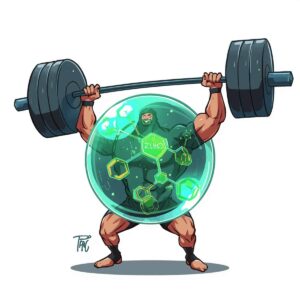
A fascinating study has been done on how terpenes are the heavy lifters of your high. Sure, THC is the catalyst to the marvelous experience of being inebriated, although there is a whole lot more to it.
Think of a car as your experience where THC is the engine, terpenes would be your steering wheel. They are the chemicals that affect where your experience takes you. That being the most vital part of it all. Terpenes don’t needs to bind to CB1 & CB2 receptors to make you feel good. They work on different receptors, pathways and channels.
• GABA receptors (calming) — linalool
GABA is your chill chemical. When linalool boosts it, your nervous system relaxes.
• Serotonin receptors (mood + anxiety) — limonene
This is why limonene feels bright, optimistic, and mentally clear.
• Acetylcholine pathways (memory + focus) — pinene
Pinene literally reduces memory fog. It sharpens the mind.
• TRPV1 channels (pain modulation) — myrcene
Myrcene interacts with pain-sensing ion channels and may influence inflammation.
You can find these terpenes listed in our products descriptions. There are over 300 000 known terpenes in nature (they are basically countless). In cannabis there are 200+ known terpenes and only 8-12 of them are super prolific.
Every combination of terpenes creates a different feeling, therefor every dosage is highly unique, even if it’s the same strain. Terpenes have always secretly been the drivers to our experiences, not the THC or CBD itself.
Brain function & heavy/lifetime use
The research has shown its not all sunshine and rainbows on the cannabis side of the hill. As can be expected with anything, overuse or lifetime use has negative effects.
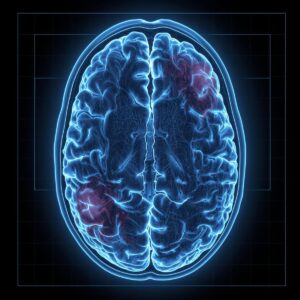
A large study of young adults (22-36 yrs) found that heavy lifetime use of cannabis was associated with reduced brain activity in key regions during working-memory tasks.
Regions affected: dorsolateral & dorsomedial prefrontal cortex, anterior insula.
Implication: While many effects may be subtle, there’s measurable cognitive impact tied to usage history.
Let’s discuss what these parts of the brain are responsible for:
Dorsolateral Prefrontal Cortex (DLPFC)
Role: Executive function — your mental “CEO.”
It’s responsible for:
working memory
decision-making
planning
impulse control
staying organized
Dorsomedial Prefrontal Cortex (DMPFC)
Role: Social thinking + self-awareness.
It’s involved in:
understanding your own thoughts
reading other people’s intentions
emotional regulation
evaluating consequences
It’s the part of you that goes, “Maybe I shouldn’t text my ex.”
(Important life function.)
Anterior Insula
Role: Emotional processing + body awareness.
It handles:
internal signals like heartbeat, tension, gut feeling
emotional intensity
anxiety responses
pain perception
This is the region that tells you “I’m stressed,” “I’m hungry,” or “I’m about to panic.”
As you can tell, these are all vital parts of your life. Not being fully in control of these systems leaves you almost emotionally disabled. Granted these parts of your brain are only at risk to everyday & heavy users.
Cannabis and Adaptogens
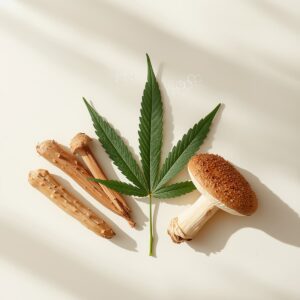
Cannabis and the ECS (Endocannabinoid System) is not the be all and end all. The are many other ways to manipulate your internal processing systems. Adaptogens work on stress-response pathways, neurotransmitters, and inflammation cycles. Adaptogens are amazing!
So, what happens when you mix cannabis and adaptogens together? Chaos one would think, yet the result is actually rather sound. Cannabis = system-wide regulator + Adaptogens = system stabilisers Put them together and you get synergy, not chaos.
Let’s discuss some mixes:
Cannabis + Ashwagandha → Stress Regulation & Emotional Balance
Ashwagandha is an ancient Ayurvedic adaptogen: A natural herb that helps the body regulate stress, balance hormones, and stabilise the nervous system.
When Cannabis and Ashwagandha are used together, they create a calm-but-clear state by lowering cortisol, relaxing the nervous system through CB1 pathways, reducing anxiety reactivity, easing emotional tension, improving sleep quality, and smoothing out the mental noise that causes overthinking, essentially giving the body and mind a more stable, grounded baseline without sedation.
Cannabis + Lion’s Mane → Neuroplasticity & Cognitive Flow
Lion’s Mane is a medicinal mushroom known for stimulating nerve growth factor (NGF), enhancing neuroplasticity, supporting cognitive clarity, and reducing inflammation in the brain.
When combined with cannabis, this duo creates a calm-focus state where Lion’s Mane enhances brain flexibility, clarity, and long-term cognitive support, while cannabis boosts creativity, improves pattern recognition, and brings a relaxed-but-alert neural tone (especially with pinene- or limonene-rich profiles). Together, they produce a smooth, creative mental flow that’s ideal for problem-solving, imagination, deep work, and emotional resilience.
Cannabis + Reishi → Immune Balance & Restorative Reset
Reishi is a medicinal mushroom and adaptogen known for stabilising the immune system, deepening rest and recovery, reducing inflammation, and smoothing mood and stress responses.
When paired with cannabis, the two create a restorative, body-balancing effect where Reishi regulates the immune system and supports long-term recovery, while cannabis activates CB2 pathways to reduce inflammation, calm the body, and promote healthier sleep cycles. Together, they form a recovery-focused duo ideal for easing chronic stress, preventing burnout, restoring immune balance, improving sleep issues, and settling inflammation loops.
Cannabis, Dopamine & Psychosis Risk

What the Research Actually Shows
Recent brain-imaging studies have discovered something important:
People with cannabis-use disorder (heavy or long-term chronic use) show increased neuromelanin, a by-product of dopamine metabolism, in brain regions associated with psychosis.
What does dopamine have to do with this?
Dopamine isn’t a “pleasure chemical” — it’s a prediction and salience chemical. Salience: The brain deciding what deserves your attention.
Too much activity in certain dopamine pathways can make the brain:
misinterpret signals
exaggerate threats
become overly sensitive to stress
distort perception
These are the same pathways that play a role in psychosis. When dopamine misfires, the brain can start assigning way too much importance to normal things. Sounds, thoughts, emotions, glances, sensations.
What does neuromelanin tell us?
Neuromelanin builds up when dopamine is overproduced or overly active.
Finding more neuromelanin in key brain regions suggests: The dopamine system has been chronically overstimulated.
What is too much cannabis though
MG Per Day: 20–30 mg of THC per day or more (regularly)
How Many 1G Joints per Day Is “Too Much”:
1 full 1G joint per day = high use
2–3 per day = very high use
4+ per day = extremely heavy use
Bongs per Day, Using Your 0.4g Measurement:
1 bong per day = moderate-heavy
2–3 bongs per day = heavy
4–6 bongs per day = very heavy
7+ daily = extreme use category
Conclusion
New discoveries about cannabis will always surface, some positive, some negative, all worth paying attention to. The best we can do is stay curious, study the information, and take it into account with a healthy pinch of salt. No study is ever 100% final, but each one helps us understand the plant a little better.